
The Research Group in Algorithms and Optimization focuses on developing new approaches in mathematical optimization and algorithm design to tackle computational questions arising in a wide range of areas, with a particular focus on problems at the interface of economics and computation. We combine methods from discrete and continuous optimization, computer science, game theory, and economics to develop efficient and exact approximation algorithms, and to understand the limits of computability.
Our group was established in August 2024 as part of the Transdisciplinary Research Area (TRA) Modelling at the University of Bonn, and is lead by the Hertz Professor László Végh.
We are connected to the Research Institute for Discrete Mathematics, the Institute of Computer Science, and the Department of Economics.
As of 5th February 2026 the team has a new address. We are now located at "Am Propsthof 49, 53121 Bonn".
Three papers from our group got accepted to SODA 2026. For more information, please follow this link.
Our team member Hannaneh Akrami has been selected as one of only two scientists for the Minerva Fast Track programme. Please, follow the link to the article published on the MPI website.
Date: 12.10.2026, 14:00 (s.t.)
Location: Am Propsthof 49, Seminar Room
Speakers: Matthias Mnich
We nearly settle the polynomial-time approximability of the Directed Feedback Vertex Set problem in tournaments. This problem is Vertex Cover-hard, and thus cannot have a (2−ε)-approximation for any ε>0 in polynomial time assuming the Unique Games Conjecture. In the past 28 years, several works have attempted to attain this approximability barrier of 2, and have designed algorithms with smaller and smaller approximation factors. This includes a 5/2-approximation by Cai, Deng and Zang (FOCS 1998, SICOMP 2001); a 7/3-approximation by Mnich, Vassilevska Williams and Végh (ESA 2016), another 7/3-approximation by Aprile, Drescher, Fiorini and Huynh (DAM 2023), and a 9/4-approximation by Ghorbani and Mnich (ICALP 2026). Our main result improves upon all of those works: we give the first deterministic polynomial-time (2+ε)-approximation for Directed Feedback Vertex Set in tournaments, for all ε>0. We thereby almost answer an open question by Lokshtanov, Misra, Mukherjee, Panolan, Philip and Saurabh (SODA 2020) who asked for a deterministic 2-approximation in polynomial time. Furthermore, we extend our result to the broader class of quasi-transitive digraphs.Date: 30.09.2026, 14:00 (s.t.)
Location: Am Propsthof 49, Seminar Room
Speakers: Maxim Soldatov
Date: 29.09.2026, 15:00 (s.t.)
Location: Am Propsthof 49, Seminar Room
Speakers: Sergio J. Hernando Rivero
Date: 28.09.2026, 10:00 (s.t.)
Location: Am Propsthof 49, Seminar Room
Speakers: El Amine Bouchti
Date: 29.06.2026, 14:00 (s.t.)
Location: Am Propsthof 49, Seminar Room
Speakers: Ruilong Zhang
We study the problem of allocating items to agents with submodular valuations with the goal of maximizing the weighted Nash social welfare. The best-known results for the unweighted and weighted objectives are the 4 + epsilon approximation given by Garg, Husic, Li, Végh, and Vondrák and the 233 + epsilon approximation given by Feng, Hu, Li, and Zhang, respectively. We present a 3.56 + epsilon approximation algorithm for weighted Nash social welfare maximization with submodular valuations, simultaneously improving the previous approximation ratios for both the weighted and unweighted problems. Our algorithm solves the configuration LP via a stronger separation oracle that loses an e/(e − 1) factor only on small items, and then rounds the solution using a new bipartite multigraph construction. Key technical ingredients include a greedy proxy function that is additive within each configuration, preserves the LP value, and lower-bounds the rounded solution, together with refined concentration bounds and a series of mathematical programs analyzed partly with computer assistance.Date: 24.06.2026, 14:00 (s.t.)
Location: Am Propsthof 49, Seminar Room
Speakers:
- Paul Müller: Few-Cut Fair Division: Topological and Algorithmic Bounds for Cake-Cutting with Entitlements
- Yuheng Shi: Circuit imbalance measure and matroid representability
- Sergio Hernando Rivero: Hardness of Approximation for TSP
Date: 22.06.2026, 14:00 (s.t.)
Location: Am Propsthof 49, Seminar Room
Speakers:
- Julian Paschedag: Efficient solvability of linear complementarity problems
- Florian Coenen: Fast Push-Relabel-Algorithms for Maximum Flow
Date: 15.06.2026, 14:00 (s.t.)
Location: Am Propsthof 49, Seminar Room
Speakers: Daniel Emse
Maxim Soldatov will also be giving his first talk on his Bachelor's Thesis “Improvements on Fair Allocation of Chores with Restricted Additive Costs”.
Date: 10.06.2026, 14:00 (s.t.)
Location: Am Propsthof 49, Seminar Room
Speakers: Miká Kruschel
Date: 18.05.2026, 14:00 (s.t.)
Location: Am Propsthof 49, Seminar Room
Speakers: Chris Cohadari
We present ongoing work on synergies for Linear and Semidefinite Programming (LP, SDP) approaches to the Maximum Cut (MaxCut) problem. Specifically, we focus on novel preprocessing and branching techniques along with (extending) their theoretical foundations. For instance, we propose a new branching rule that is inspired by the fact that, when using common LP/SDP formulations, it is sufficient to enforce integrality on the edges of a spanning tree (Mallach, ISCO 2024). Moreover, we report on progress regarding a unified view on preprocessing for MaxCut and the equivalent Quadratic Unconstrained Binary Optimization problem. To this end, we analyse the relationship between the respective preprocessing rules and derive new ones by combining techniques from both sides.Date: 11.05.2026, 14:00 (s.t.)
Location: Am Propsthof 49, Seminar Room
Speakers: Timo Reichert
We study the fair allocation of indivisible items among agents with additive
valuations. Within the literature, two large categories of fairness notions have
emerged: share-based and envy-based notions. Among share based notions,
MMS and its relaxations are most prevalent, while the focus among envy-based
notions has commonly been on EFX and one of its relaxations, EF1. While these
notions are often studied on their own, recent works have shown the existence
of allocations of goods satisfying cardinal MMS guarantees and EFX or EF1
simultaneously.
Motivated by these results, we initiate the study of combining ordinal MMS
approximations with envy-based notions for goods instances. We establish the
existence of allocations that satisfy the 1-out-of-d MMS property (i) for d =
⌈3n/2⌉, combined with EFX for ordered instances; (ii) for d = ⌈3n/2⌉, combined
with EF1 for top-n instances; and (iii) for d = 4⌈n/3⌉, combined with EF1 for
ordered instances. In particular, this achieves the state-of-the-art ordinal MMS
approximation.
We also study the interaction between MMS and EF1 guarantees for chores
for the first time. Here, we show the existence of allocations that are (iv)
1-out-of-⌊2n/3⌋ together with EF1 for instances which are both top-n and top-
2⌊2n/3⌋; and (v) 3/2-MMS together with EF1 for top-n instances.
Date: 13.04.2026, 14:00 (s.t.)
Location: Am Propsthof 49, Seminar Room
Speakers: Leo Diedering, Sergio Hernando Rivero, Yuheng Shi, Jakob Gierschmann
- Leo Diedering: Disjoint Paths in Structurally Bounded Graphs (I)
- Sergio Hernando Rivero: On the Hardness of Approximation of TSP (I)
- Yuheng Shi: Circuit Imbalance Measure and Integer Linear Programming (I)
- Jakob Gierschmann: Fair and Efficient Division of Goods Beyond Additivity (II)
Date: 18.03.2026, 14:00 (s.t.)
Location: Am Propsthof 49, Seminar Room
Speakers: Hannaneh Akrami
We study the fundamental problem of fairly dividing a set of indivisible goods among agents with additive valuations. Here, envy-freeness up to any good (EFX) is a central fairness notion and resolving its existence is regarded as one of the most important open problems in this area of research. Two prominent relaxations of EFX are envy-freeness up to one good (EF1) and epistemic EFX (EEFX). While allocations satisfying each of these notions individually are known to exist even for general monotone valuations, whether both can be satisfied simultaneously remains open for all instances in which the EFX problem is itself unresolved.
In this work, we show that there always exists an allocation that is both EF1 and EEFX for additive valuations. We introduce a new share-based fairness notion, termed strong EEFX share, which may be of independent interest and which implies EEFX feasibility of bundles. We show that this notion is compatible with EF1, leading to the desired existence result.
This is based on a joint work with Ryoga Mahara, Kurt Mehlhorn, and Nidhi Rathi.
Date: 28.01.2026, 15 c.t.
Location: Computer Science Department, Friedrich-Hirzebruch-Allee 8, room 2.074
Speakers: David Čadež
Please Take Note of the Non-Standard Time and Location!
Date: 17.12.2025, 16:00 (s.t.)
Location: Poppelsdorfer Allee 24, Seminar Room
Speakers: Miká Kruschel, Timo Reichert, Paul Müller
- 16:00 Miká Kruschel: Approximating Distant Paths in Planar Graphs (II)
- 16:35 Timo Reichert: Combining MMS and EFX Guarantees for Fair Division (II)
- 17:10 Paul Müller: Few-Cut fair division: Topological and Algorithmic bounds for Cake-cutting with Entitlements (I)
Date: 19.11.2025, 14 c.t.
Location: Poppelsdorfer Allee 24, Seminar Room
Speaker: Siyue Liu
Consider a matroid where all elements are labeled with an integer. We are interested in finding a base where the sum of the labels is congruent to g mod m. We show that this problem is fixed-parameter tractable if we parametrize by m when m is either the product of two primes or a prime power. The algorithm can be generalized to all moduli and, in fact, to all abelian groups if a classic additive combinatorics conjecture by Schrijver and Seymour holds true. We also discuss the optimization version of the problem. Joint work with Chao Xu.
Date: 29.10.2025, 14 c.t.
Location: Poppelsdorfer Allee 24, Seminar Room
Speaker: Hannaneh Akrami
We consider the problem of guaranteeing maximin-share (MMS) when allocating a set of indivisible items to a set of agents with fractionally subadditive (XOS) valuations.
For XOS valuations, it has been previously shown that for some instances no allocation can guarantee a fraction better than 1/2 of maximin-share to all the agents. Also, a deterministic allocation exists that guarantees 0.2192 of the maximin-share of each agent.
We derive approximation guarantees for both deterministic and randomized allocations. On the deterministic side, we improve the best approximation guarantee to 3/13 = 0.2307. Furthermore, we investigate randomized algorithms and the Best-of-both-worlds fairness guarantees. We propose a randomized allocation that is 1/4-MMS ex-ante and 1/8-MMS ex-post. Moreover, we prove an upper bound of 3/4 on the ex-ante guarantee.
This is a joint work with Kurt Mehlhorn, Masoud Seddighin, and Golnoosh Shahkarami.
Date: 08.10.2025, 14 c.t.
Location: Poppelsdorfer Allee 24, Seminar Room
Speaker: Lilian Witters
Lilian will be presenting recent work of Kumar and Swamy:
We consider the k-edge connected spanning subgraph (k-ECSS) problem, where we are given an undirected graph G = (V, E) with nonnegative edge costs c_e , and the goal is to find a minimum-cost subgraph H of G that is k-edge connected, i.e., there exist at least k edge-disjoint paths between every pair of vertices in H. For even k, we present a polynomial time algorithm that computes a (k − 2)-edge connected subgraph of cost at most that of the optimal k-edge connected subgraph of G; for odd k, we obtain a (k−3)-edge connected subgraph of cost at most the optimum. In fact, the cost of our solution does not exceed the optimal value, OPT of the natural LP-relaxation for k-ECSS. Since k-ECSS is APX-hard for all values of k ≥ 2, our results are nearly optimal. They also significantly improve upon the recent work of Hershkowitz, Klein, and Zenklusen, both in terms of solution quality and the simplicity of algorithm and its analysis. Interestingly, our techniques also yield an alternate guarantee, where we obtain a (k − 1)-edge connected subgraph of cost at most 1.5 · OPT; with unit edge costs, the cost guarantee improves to 1 + (4/3k) · OPT, which improves upon the state-of-the-art approximation guarantee for unit edge costs, albeit with a unit loss in edge connectivity.
Date: 10.09.2025, 14 c.t.
Location: Poppelsdorfer Allee 24, Seminar Room
Speaker: Henri Saal
The Divide and Concur heuristic is a general technique to find a point in the intersection of m sets. Divide and Concur introduces a copy of every variable for each set and reformulates the problem as the intersection of two sets in the product space. The arising problem can be solved via iterative methods like alternating projections or Douglas-Rachford. In this talk, we prove convergence for the general convex case. Furthermore, for the special case of systems of linear equations, we show linear convergence and provide numerical experiments.
Date: 26.05.2025, 14 c.t.
Location: Poppelsdorfer Allee 24, Seminar Room
Speaker: Attila Jung
Two celebrated extensions of Helly's theorem are the Fractional Helly theorem of Katchalski and Liu (1979) and the Quantitative Volume theorem of Barany, Katchalski, and Pach (1982). Improving on several recent works, we prove an optimal combination of these two results. We show that given a family $F$ of $n$ convex sets in $\mathbb{R}^d$ such that at least $\alpha \binom{n}{d+1}$ of the $(d+1)$-tuples of $F$ have an intersection of volume at least 1, then one can select $\Omega_{d,\alpha}(n)$ members of $F$ whose intersection has volume at least $\Omega_d(1)$.
Joint work with Nóra Frankl and István Tomon.
Date: 05.05.2025, 14 c.t.
Location: Poppelsdorfer Allee 24, Seminar Room
Speaker: Matthias Kaul
We study the problem of partitioning a set of n objects in a metric space into k clusters V_1, . . . , V_k . The quality of the clustering is measured by considering the vector of cluster costs and then minimizing some monotone symmetric norm of that vector (in particular, this includes the ℓp-norms).
For the costs of the clusters we take the weight of a minimum-weight spanning tree on the objects in V_i, which may serve as a proxy for the cost of traversing all objects in the cluster, for example in the context of Multirobot Coverage as studied by Zheng, Koenig, Kempe, Jain (IROS 2005), but also as a shape-invariant measure of cluster density similar to Single-Linkage Clustering.
This problem has been studied by Even, Garg, Könemann, Ravi, Sinha (Oper. Res. Lett., 2004) for the setting of minimizing the weight of the largest cluster (i.e., using ℓ∞) as Min-Max
Tree Cover, for which they gave a constant-factor approximation algorithm. We provide a careful adaptation of their algorithm to compute solutions which are approximately optimal with respect to all monotone symmetric norms simultaneously, and show how to find them in polynomial time.
As an extension, we also consider the case where instead of a target number of clusters we are provided with a set of depots in the space such that every cluster should contain at least one such depot. One can consider these as the fixed starting points of some agents that will traverse all points of a cluster. For this setting also we are able to give a polynomial-time algorithm computing a constant-factor approximation with respect to all monotone symmetric norms simultaneously. To show that the algorithmic results are tight up to the precise constant of approximation attainable, we also prove that such clustering problems are already APX-hard when considering only one single ℓp norm for the objective.
This is based on joint work with Kelin Luo, Matthias Mnich, and Heiko Röglin.
Date: 25.04.2025
Location: Endenicher Allee 60, Center for Mathematics, Lipschitz-Hall
Program and Registration: https://www.uni-bonn.de/en/research-and-teaching/research-profile/transdisciplinary-research-areas/tra-1-modelling/events/reports/inauguration_symposium
Date: 24.02.2025, 14 c.t.
Location: Poppelsdorfer Allee 24, Seminar Room
Speaker: Haoyuan Ma
We investigate a variant of the trust region interior point method (TR-IPM) which was originally given by Lan, Monteiro and Tsuchiya (SIAM J. Optim. 2009). We show that the iteration complexity of this algorithm is essentially optimal in the L2-neighbourhood of the central path. Namely, the iteration complexity of the TR-IPM is upper bounded by the minimum number of segments of any piecewise linear curve traversing in a close L2-neighbourhood of the central path. This strengthens the previous bounds that were in terms of the Dikin-Todd-Stewart conditional number of the constraint matrix.
Lan, Monteiro and Tsuchiya only gave a weakly polynomial algorithm for solving the trust region problem, and left it as an open question to develop a strongly polynomial algorithm. We resolve this question by presenting a new strongly polynomial algorithm that solves a parametric minimum norm problem to a very high accuracy. As a result, each iteration of our TR-IPM can be implemented in strongly polynomial time. Our algorithm for the parametric problem relies on approximately computing the singular value decomposition of an associated matrix. These singular values enable us to locate the optimal parameter value in a narrow interval, where Newton's method exhibits quadratic convergence.
This is based on joint work with Daniel Dadush, Bento Natura, and László Végh.
Date: 27.01.2025, 14 c.t.
Location: Poppelsdorfer Allee 24, Seminar Room
Speaker: Roshan Raj
Two matrices are said to be principal minor equivalent if they have equal corresponding principal minors of all orders. We give a characterization of principal minor equivalence and a deterministic polynomial time algorithm to check if two given matrices are principal minor equivalent. Earlier such results were known for certain special cases like symmetric matrices, skew-symmetric matrices with {0, 1, -1}-entries, and matrices with no cuts (i.e., for any non-trivial partition of the indices, the top right block or the bottom left block must have rank more than 1). As an immediate application, we get an algorithm to check if the determinantal point processes corresponding to two given kernel matrices (not necessarily symmetric) are the same. As another application, we give a deterministic polynomial-time test to check equality of two multivariate polynomials, each computed by a symbolic determinant with a rank 1 constraint on coefficient matrices.
László Végh
Hertz Chair for Algorithms and Optimization
Phone extension: 9557
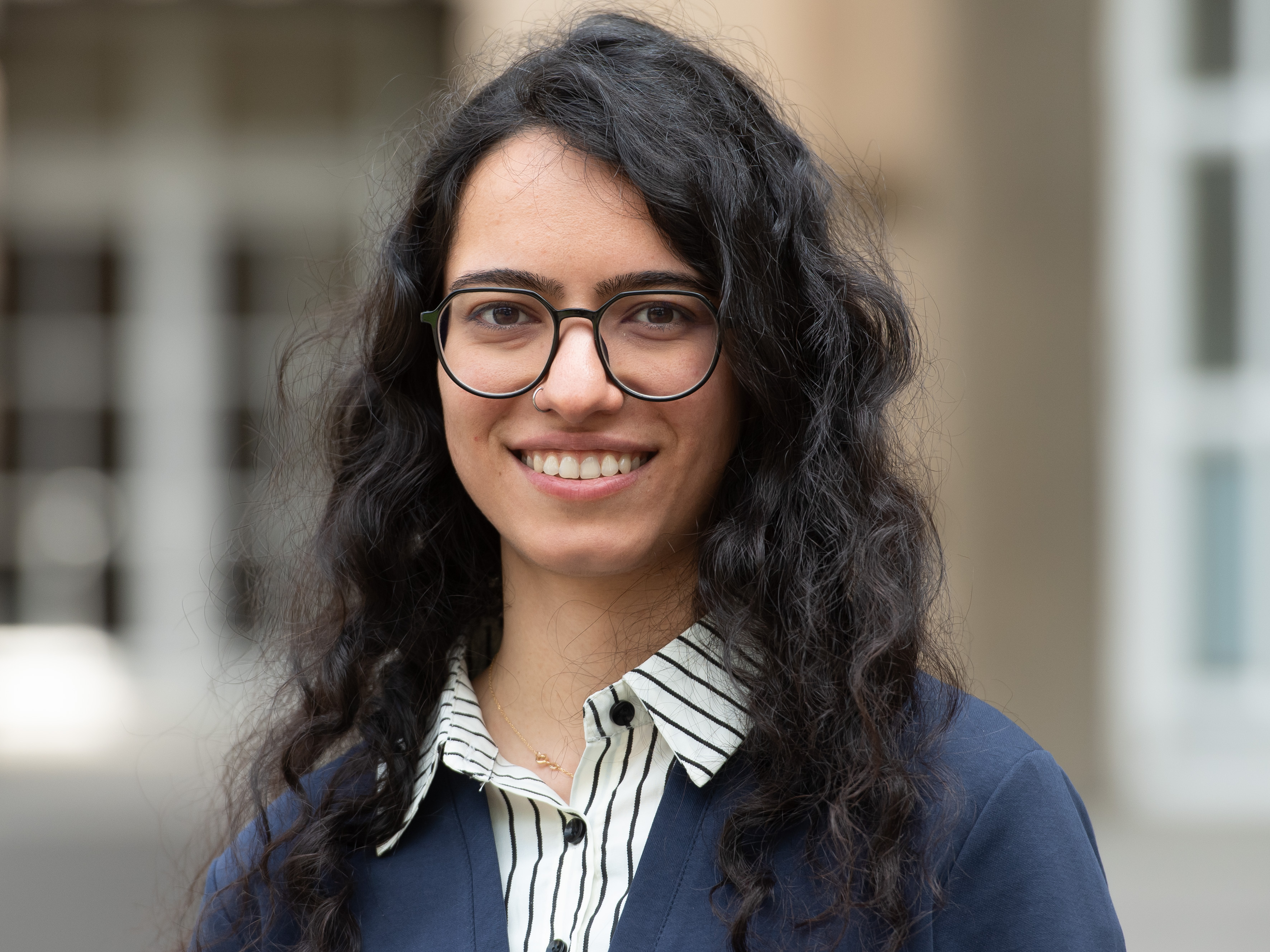
Hannaneh Akrami
Postdoctoral Researcher
Phone extension: 9550

Matthias Kaul
Postdoctoral Researcher
Phone extension: 9552
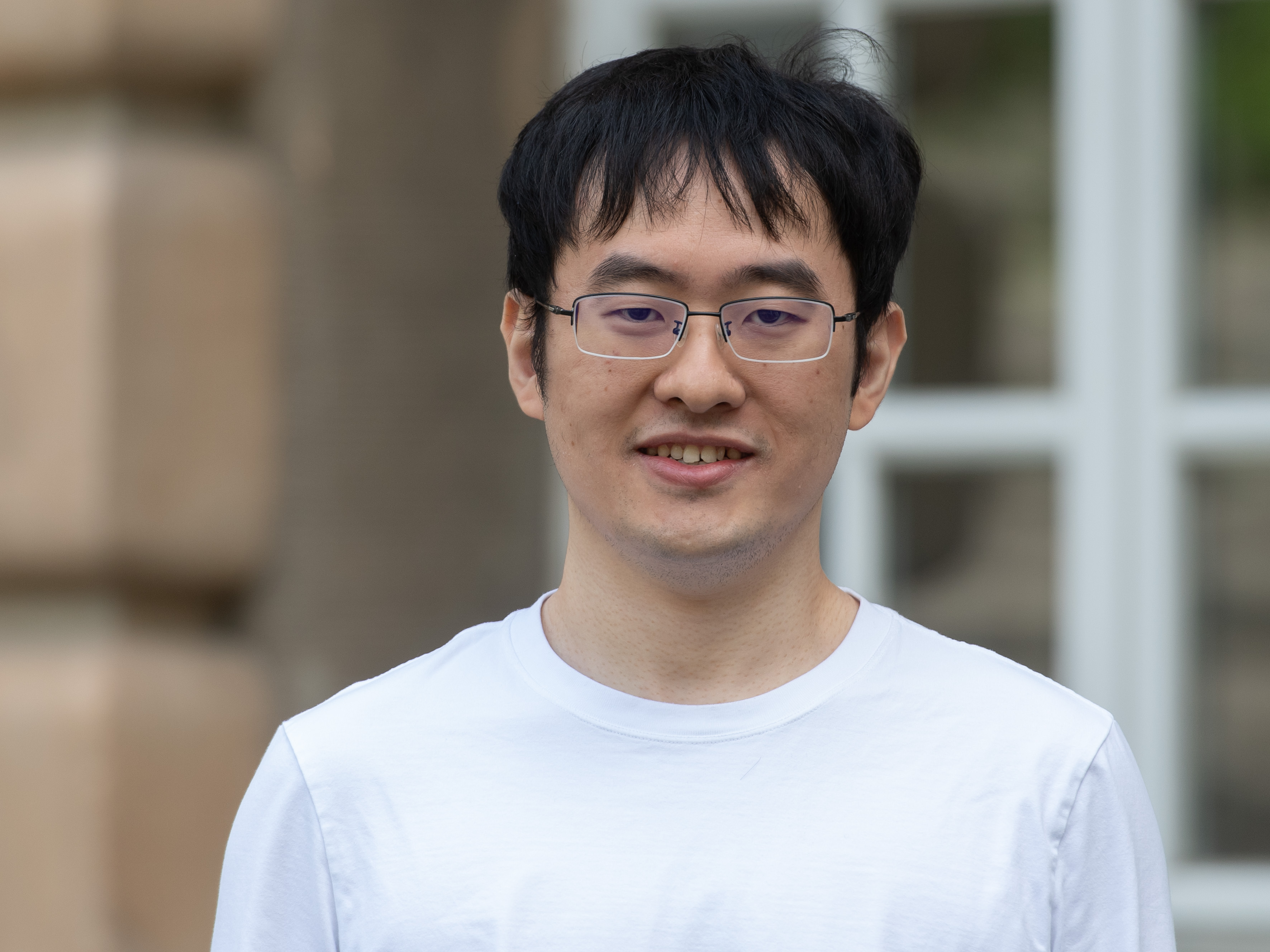
Wenzheng Li
Postdoctoral Researcher
Phone extension: 9553
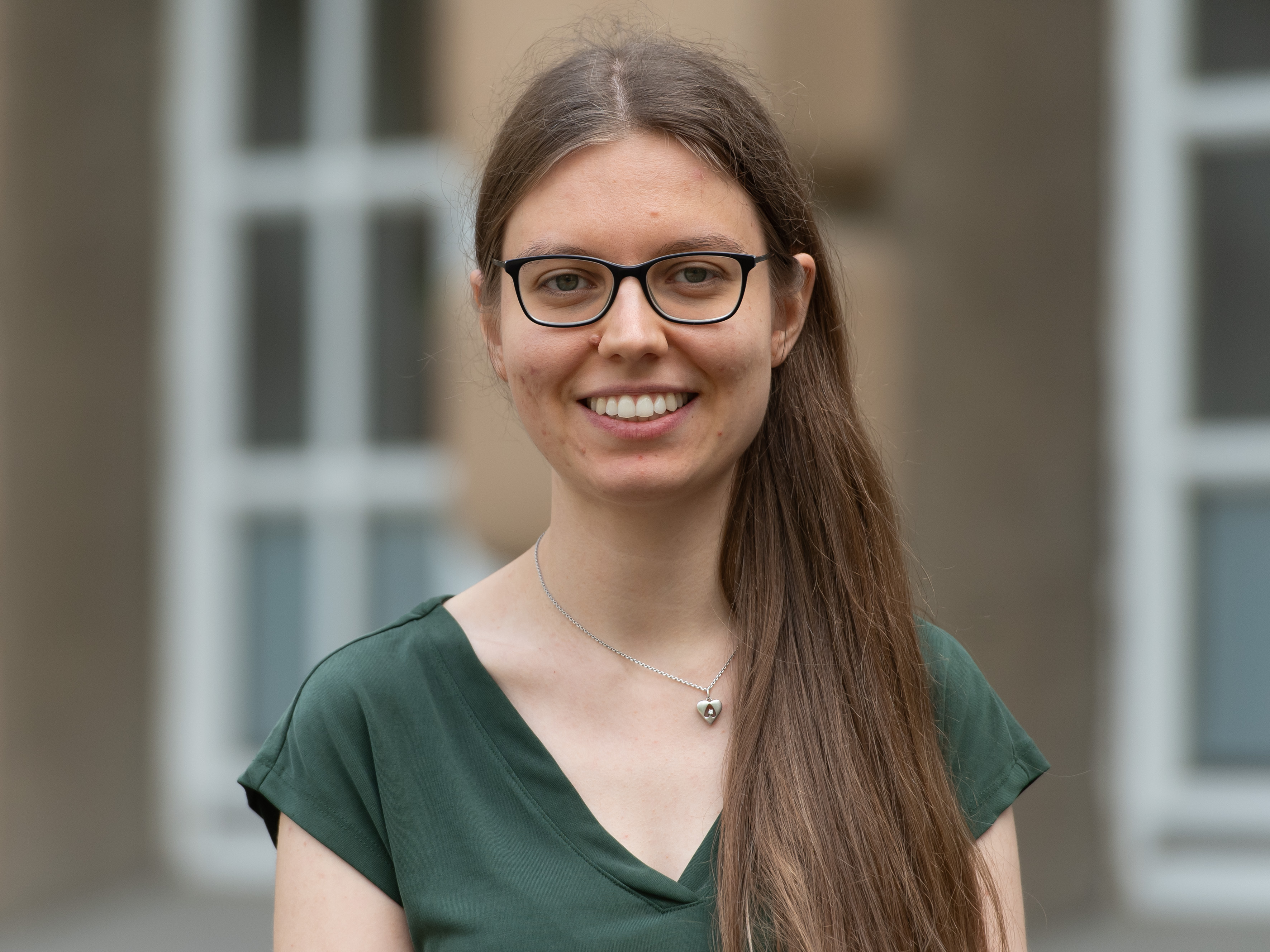
Sophia Heimann
Doctoral Student
Phone extension: 9555
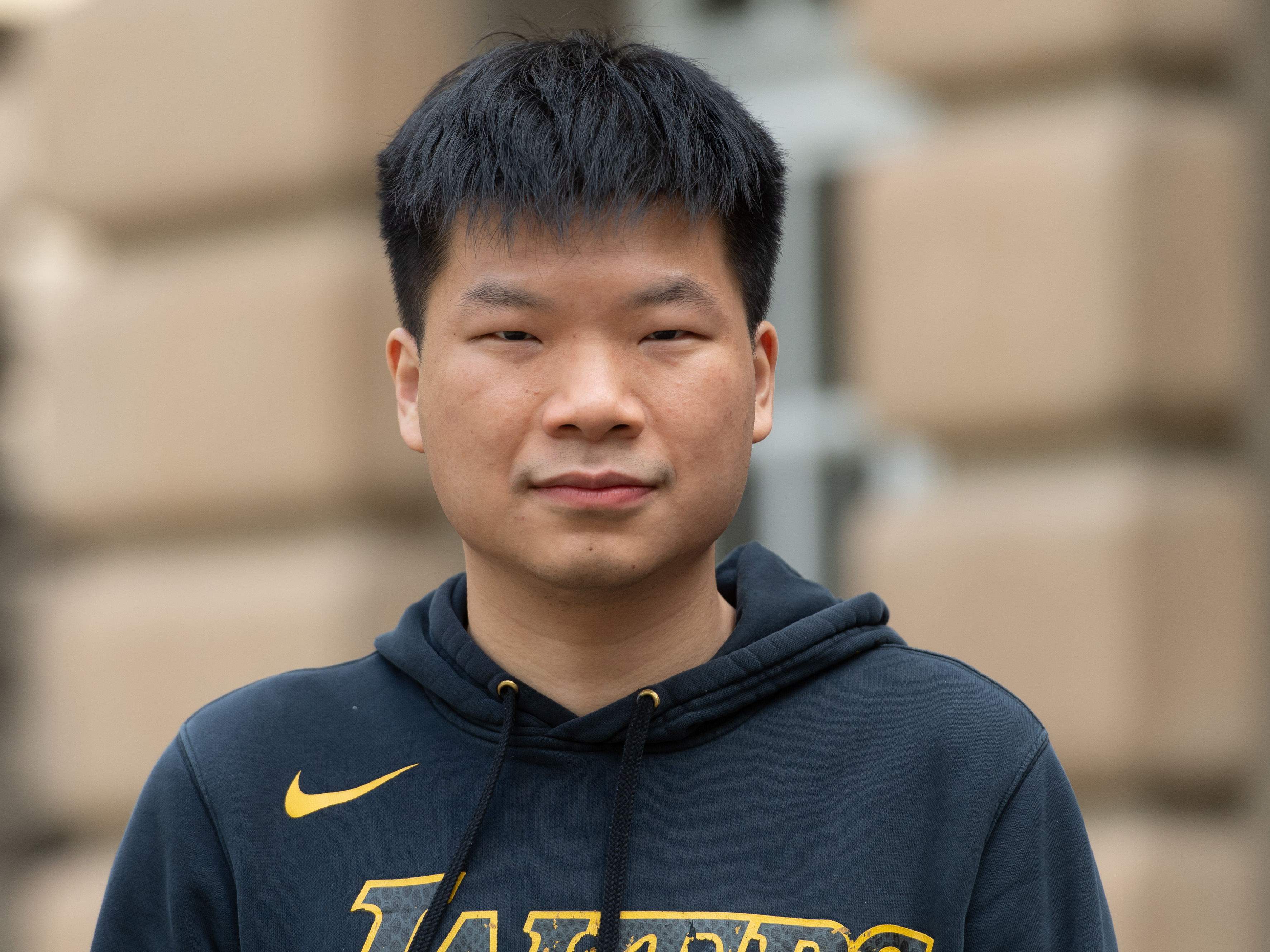
Haoyuan Ma
Doctoral Student
Phone extension: 9554

Jakob Gierschmann
Master's Student
Lillian Witters
Master's Student
Johann Haas-Jobelius
Master´s Student
Leo Diedering
Master's Student
Sergio Rivera
Master's Student
Yuheng Shi
Master´s Student

Attila Jung
Former Guest Researcher

David Čadež
Former Master's Student

Henri Alexander Saal
Former Master's Student

Timo Reichert
Former Master´s Student

Miká Kruschel
Former Master Student
Upcoming Courses for the Summer Term 2026
Hauptseminar Algorithmen und Optimierung: Spectral Graph Theory and Applications
Lecturer: László Végh,
Haoyuan Ma, Wenzheng Li
Graduate Seminar on Algorithms and Optimization: Metric Embeddings and Applications
Lecturer: László Végh,
Matthias Kaul, Wenzheng Li
Contact
To visit us, please go to the side entrance of our building, as marked on the map above. Once there, you will find a small pillar with an intercom. Use that to call the office extension of the person you are visiting, they will then let you into the building. Our offices are on the first floor.